
Stop Adding “S” to These Words! 🇬🇧
Stop Adding “S” to These Words! 🇬🇧

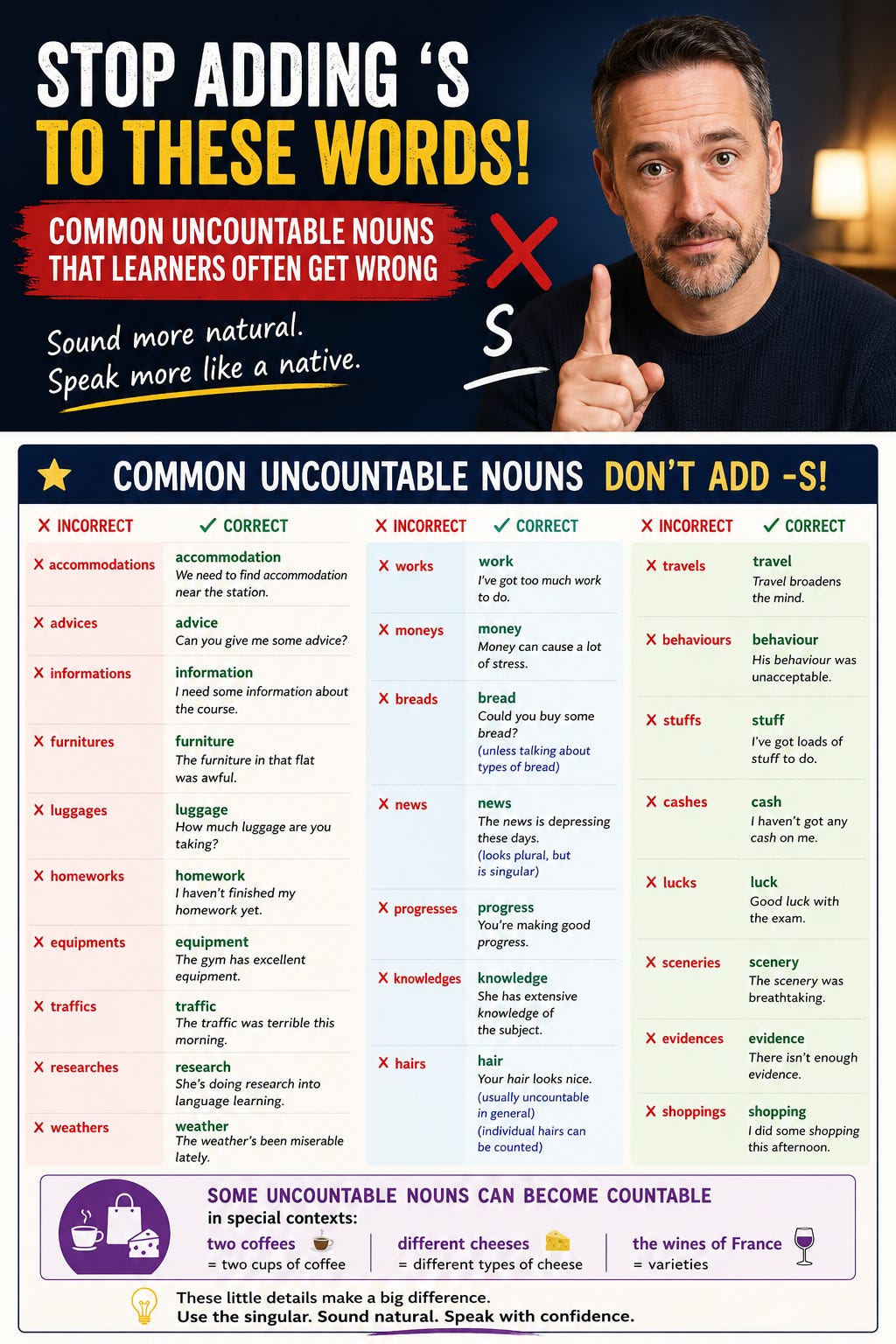
One of the quickest ways to sound slightly unnatural in English is by adding -s to nouns that are normally uncountable.
Even very advanced learners sometimes say things like:
❌ advices
❌ informations
❌ furnitures
❌ homeworks
❌ accommodations
In standard British English, these forms usually sound incorrect because the nouns are treated as uncountable.
Here are some of the most common examples:
accommodation
“We need to find accommodation near the station.”advice
“Can you give me some advice?”information
“I need some information about the course.”furniture
“The furniture in that flat was awful.”luggage
“How much luggage are you taking?”homework
“I haven’t finished my homework yet.”equipment
“The gym has excellent equipment.”traffic
“The traffic was terrible this morning.”research
“She’s doing research into language learning.”weather
“The weather’s been miserable lately.”
And there are many more:
work
“I’ve got too much work to do.”money
“Money can cause a lot of stress.”bread
“Could you buy some bread?”news
“The news is depressing these days.”
(It looks plural, but it’s grammatically singular.)progress
“You’re making good progress.”knowledge
“She has extensive knowledge of the subject.”hair
“Your hair looks nice.”
(Usually uncountable when talking generally, although individual hairs can be counted.)travel
“Travel broadens the mind.”behaviour
“His behaviour was unacceptable.”stuff
“I’ve got loads of stuff to do.”cash
“I haven’t got any cash on me.”luck
“Good luck with the exam.”scenery
“The scenery was breathtaking.”evidence
“There isn’t enough evidence.”shopping
“I did some shopping this afternoon.”
English becomes even more confusing because some uncountable nouns can become countable in special contexts:
two coffees (= two cups of coffee)
three teas (= three cups of tea)
different cheeses (= different types of cheese)
the wines of France (= varieties of wine)
So yes — English occasionally breaks its own rules just to keep learners on their toes.
These small details may seem minor, but they make a big difference if you want your English to sound more natural, accurate, and confident at C1/C2 level.